Cima Evidence Brief #03: What Works in Behavioral School-based Violence Prevention?
Date issued
July 2026
Subject
Educational Institution;
Violence Prevention;
Income Distribution;
Impact Evaluation;
Childhood;
Regulation;
Education;
Public Policy;
Bullying;
Mental Health;
School Violence
JEL code
I21 - Analysis of Education;
I28 - Government Policy;
I12 - Health Behavior;
O15 - Human Resources • Human Development • Income Distribution • Migration;
C93 - Field Experiments
Category
Catalogs and Brochures
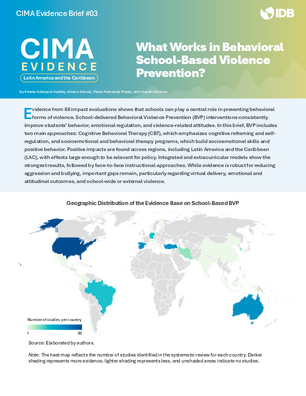
Evidence from 88 impact evaluations shows that schools can play a central role in preventing behavioral forms of violence. School-delivered Behavioral Violence Prevention (BVP) interventions consistently improve students behavior, emotional regulation, and violence-related attitudes. In this brief, BVP includes two main approaches: Cognitive Behavioral Therapy (CBT), which emphasizes cognitive reframing and self-regulation, and socioemotional and behavioral therapy programs, which build socioemotional skills and positive behavior. Positive impacts are found across regions, including Latin America and the Caribbean (LAC), with effects large enough to be relevant for policy. Integrated and extracurricular models show the strongest results, followed by face-to-face instructional approaches. While evidence is robust for reducing aggression and bullying, important gaps remain, particularly regarding virtual delivery, emotional and attitudinal outcomes, and school-wide or external violence.


NO