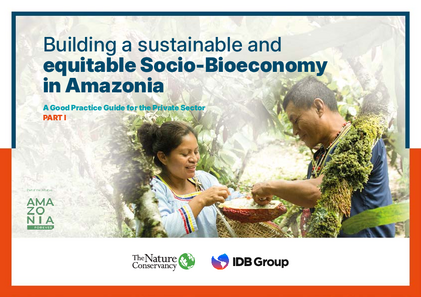
Building a sustainable and equitable SocioBioeconomy in Amazonia: A Good Practice Guide for the Private Sector. Part I
Date issued
August 2026
Subject
Biodiversity;
Indigenous Peoples;
Bioeconomics;
Governance;
Labor Force;
Women;
Environmental and Social Safeguard Strategy;
Safeguard;
Best Practices;
Environmental and Social Policy Framework;
Child Labor;
Water and Sanitation;
Environmental Management;
Labor;
Gender;
Stakeholder Ecosystem
JEL code
O13 - Agriculture • Natural Resources • Energy • Environment • Other Primary Products;
Q01 - Sustainable Development;
Q56 - Environment and Development • Environment and Trade • Sustainability • Environmental Accounts and Accounting • Environmental Equity • Population Growth
Category
Catalogs and Brochures
This guide provides the practical frameworks needed to realize that potential. Financial institutions, including IDB Invest, can use it to evaluate investments against socio-bioeconomy principles and environmental and social due diligence requirements. Companies can apply it to build sustainable, equitable and transparent supply chains. Communities can use it to articulate their governance systems and production approaches in ways that resonate with potential partners while maintaining cultural integrity. Governments can reference it to inform programs that protect community rights while facilitating responsible private sector engagement. Supporting organizations, like technical assistance providers, development agencies and NGOs can apply it to structure capacity building programs and strengthen socio-bioeconomy enabling environments. This Good Practice Guide is designed as four complementary documents that work together as a cohesive framework while also functioning independently:
Part I: Socio-Bioeconomy Assessment and Principles: Features a Socio-Bioeconomy Eligibility Assessment for rapid screening against minimum standards, followed by a detailed exploration of Seven Socio-Bioeconomy Principles, including self-assessments, recommendations for transformational practices and key concepts.
Part I: Socio-Bioeconomy Assessment and Principles: Features a Socio-Bioeconomy Eligibility Assessment for rapid screening against minimum standards, followed by a detailed exploration of Seven Socio-Bioeconomy Principles, including self-assessments, recommendations for transformational practices and key concepts.


NO