Research Insights: How Does Buyer Market Power Influence Exchange Rate Pass-through in International Trade?
 Peer Reviewed
Date issued
December 2024
Subject
Commodity Export;
Exchange Rates;
Export;
International Trade;
Small Business;
Emerging Market;
Commodity Price;
World Economy;
Export Market;
Economy;
Export Activity;
Integration and Trade
JEL code
D43 - Oligopoly and Other Forms of Market Imperfection;
E31 - Price Level • Inflation • Deflation;
F31 - Foreign Exchange;
F41 - Open Economy Macroeconomics;
F42 - International Policy Coordination and Transmission;
L10 - Market Structure, Firm Strategy, and Market Performance: General
Category
Catalogs and Brochures
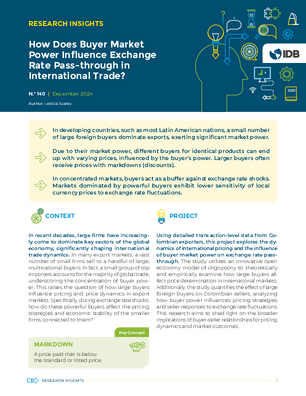
In developing countries, such as most Latin American nations, a small number of large foreign buyers dominate exports, exerting significant market power. Due to their market power, different buyers for identical products can end up with varying prices, influenced by the buyers power. Larger buyers often receive prices with markdowns (discounts). In concentrated markets, buyers act as a buffer against exchange rate shocks. Markets dominated by powerful buyers exhibit lower sensitivity of local currency prices to exchange rate fluctuations.


NO