Research Insights: How Do Firm Digital Adoption Policies Impact Labor Markets and Economic Recovery during the COVID-19 Pandemic?
 Peer Reviewed
Date issued
August 2022
Publication
Subject
Wage;
Coronavirus;
Small Business;
Labor;
Pandemics;
Gross Domestic Product;
Labor Force Participation;
Information and Communication Technology;
Digital Technology;
Self Employment;
Labor Force;
Informal Economy;
Unemployment Rate;
Labor Market
JEL code
E24 - Employment • Unemployment • Wages • Intergenerational Income Distribution • Aggregate Human Capital • Aggregate Labor Productivity;
J23 - Labor Demand;
J24 - Human Capital • Skills • Occupational Choice • Labor Productivity;
O14 - Industrialization • Manufacturing and Service Industries • Choice of Technology
Category
Catalogs and Brochures
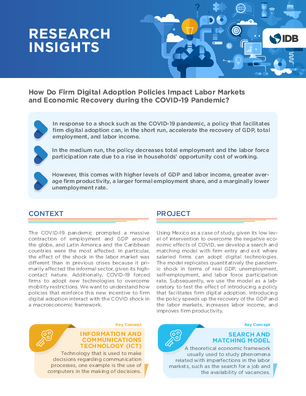
In response to a shock such as the COVID-19 pandemic, a policy that facilitates firm digital adoption can, in the short run, accelerate the recovery of GDP, total employment, and labor income. In the medium run, the policy decreases total employment and the labor force participation rate due to a rise in households opportunity cost of working. However, this comes with higher levels of GDP and labor income, greater average firm productivity, a larger formal employment share, and a marginally lower unemployment rate.


