IEEM and Ecosystem Services Modeling: Valuing Natural Capital and Ecosystem Services' Contribution to Economic Development
 Peer Reviewed
Date issued
November 2019
Subject
Sustainable Development;
Natural Capital;
Environmental Economics;
Ecosystem Service;
IEEM Platform
JEL code
Q56 - Environment and Development • Environment and Trade • Sustainability • Environmental Accounts and Accounting • Environmental Equity • Population Growth;
Q32 - Exhaustible Resources and Economic Development;
O44 - Environment and Growth;
Q57 - Ecological Economics: Ecosystem Services • Biodiversity Conservation • Bioeconomics • Industrial Ecology
Category
Catalogs and Brochures
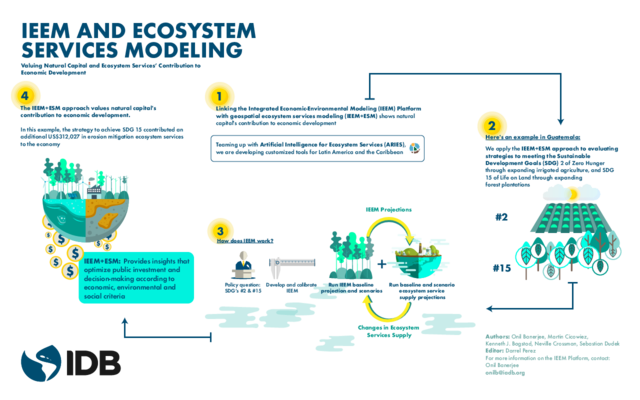
The Integrated Economic-Environmental Modeling (IEEM) Platform linked with spatial ecosystem services modeling (IEEM-ESM) is an innovative decision-making framework for exploring complex public policy goals and elucidating synergies and trade-offs between alternative policy portfolios. In this infographic, we present the IEEM-ESM approach applied to strategies to achieve the Sustainable Development Goals in Guatemala. In addition to impacts on standard economic indicators such as Gross Domestic Product and employment, we show how investments impact the value of non-market ecosystem services such as erosion mitigation services.


