Oct 2026
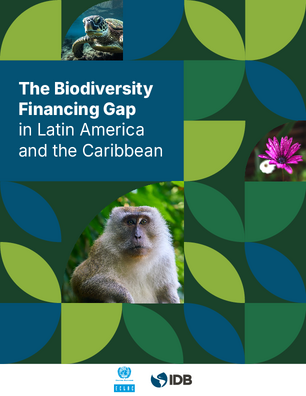
Closing the biodiversity finance gap is essential for Latin America and the Caribbean to advance toward sustainable, resilient, and inclusive development models. This requires mobilizing and…
Oct 2026
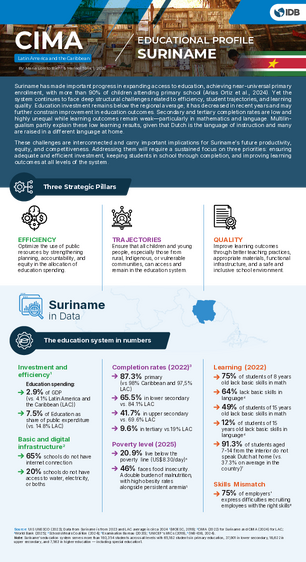
Suriname has made important progress in expanding access to education, achieving near-universal primary enrollment, with more than 90% of children attending primary school (Arias Ortiz et al., 2024…
Oct 2026
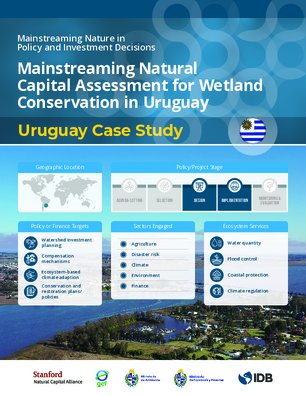
This project aimed to increase Uruguay's capacity to implement natural capital assessment and valuation approaches and apply them in the selection and design of policy and finance instruments.…
Oct 2026
This companion document to the MDB High-Level Report, Investing in Nature: Status Update on Operationalizing the Common Principles, Taxonomy, and Guide on Results Metrics for Nature, presents…
Oct 2026
This policy brief provides practical guidance for governments, multilateral development banks (MDBs), and national development banks (NDBs) on how nature credits can support the mobilization of…

Oct 2026
 Generative AI enabled
We estimate and analyze unpaid care for children, persons with disabilities, and older people in Latin America and the Caribbean using information from ten time-use surveys and imputation and…
Oct 2026
Do the boundaries of the multinational firm shape how shocks propagate through global production networks? We link U.S. Bill of Lading microdata, geocoded natural disaster records, and cross-border…
Oct 2026
Peruvian local governments manage close to 40% of national public investment, yet they execute on average only 60% of their budget. This study examines the causes of low execution at the project…
Oct 2026
This paper studies whether government-issued skill certification improves labor market integration when workers skills are hard to verify. We evaluate a randomized offer of access to an occupation-…
Oct 2026
Population ageing is raising the demand for long-term care (LTC), leading many countries to develop publicly funded LTC systems. However, little is known about whether the benefits these systems…
Oct 2026
This paper examines whether infrastructure projects that incorporate sustainability, inclusion, and resilience (SIR) components differ from traditional investments in economic appraisal outcomes.…
Oct 2026
Generative AI enabled
Generative AI enabled
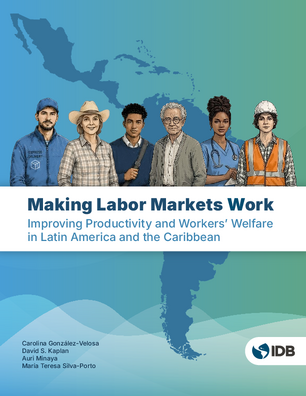
Making labor markets work, for both productivity and worker welfare, is among the most important and most neglected levers available to Latin America and the Caribbean. The region's labor market…
Oct 2026
Generative AI enabled
Generative AI enabled
This paper analyzes the association between the composition of school spending and various measures of school effectiveness. Using audited financial accounts for the universe of publicly funded urban…

Oct 2026
Using a five-year survey of over 170,000 US consumers, we provide a novel direct measure of attention to monetary policy and show that the data strongly support the predictions of a rational…
Oct 2026
Generative AI enabled
Generative AI enabled
A central obstacle to scaling many interventions is implementer quality: as a program expands and the pool of implementers broadens, average quality falls. Conversation-based interventions (…
Oct 2026
Generative AI enabled
Generative AI enabled
Severe health events are among the most common shocks households face, and in low- and middle-income countries their consequences are absorbed largely within the family. We study how a parents severe…
Oct 2026
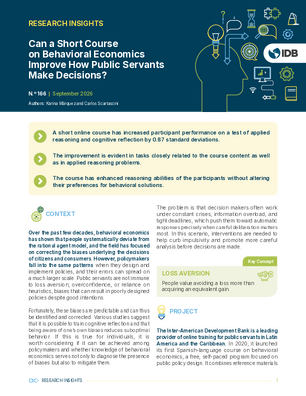
Over the past few decades, behavioral economics has shown that people systematically deviate from the rational agent model, and the field has focused on correcting the biases underlying the decisions…
Oct 2026
Generative AI enabled
Generative AI enabled
This paper examines how external demand fluctuations transmit asymmetrically to labor market outcomes in Latin America a region where structural informality and institutional rigidity shape the…
Oct 2026
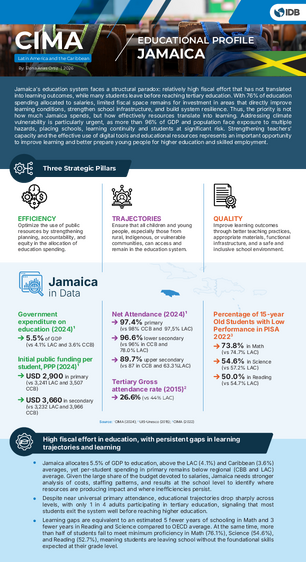
Jamaica's education system faces a structural paradox: relatively high fiscal effort that has not translated into learning outcomes, while many students leave before reaching tertiary education…
Oct 2026
Generative AI enabled
Generative AI enabled
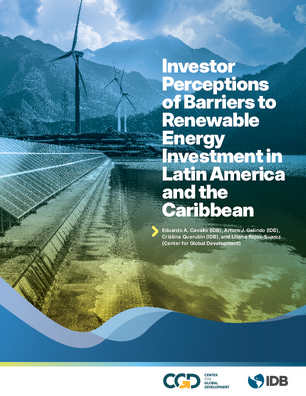
Closing Latin America and the Caribbean's infrastructure gap will require a sustained increase in private investment, particularly in the energy sector. Despite the regions strong renewable…