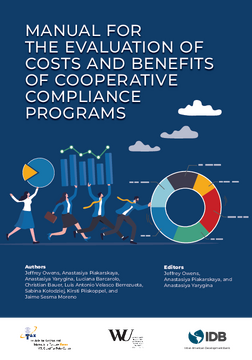
Manual for the Evaluation of Costs and Benefits of Cooperative Compliance Programs
 Peer Reviewed
Date issued
December 2025
Subject
Tax Administration;
Taxpayer;
Trust;
Tax System;
Tax Compliance;
Auditing;
Transparency and Anticorruption;
Taxation;
Labor Force;
Capital Formation;
Stakeholder Ecosystem
JEL code
D61 - Allocative Efficiency • Cost—Benefit Analysis;
H21 - Efficiency • Optimal Taxation;
H26 - Tax Evasion and Avoidance;
H83 - Public Administration • Public Sector Accounting and Audits
Category
Monographs;
Co-Publications
The Manual for the Evaluation of Costs and Benefits of Cooperative Compliance Programs provides a comprehensive methodology for assessing the performance and value of cooperative compliance programs. In an era where tax administrations increasingly seek to build trust-based relationships with taxpayers, understanding both the measurable outcomes and broader impacts of cooperative compliance programs is essential. The Manual offers a structured approach to identifying, measuring, and analyzing the costs and benefits of cooperative compliance programs, while also addressing the practical challenges of implementation, stakeholder engagement, and use of evaluation results to guide policy decisions. The Manual is a tool for tax administrations, policymakers, and other stakeholders in making informed decisions based on credible and transparent evaluation. By fostering a deeper understanding of the impacts of cooperative compliance, it contributes to the development of more effective, efficient, and trusted global tax systems.


NO