Mainstreaming Natural Capital Assessment for Wetland Conservation in Uruguay, Case Study
Date issued
October 2026
Subject
Natural Capital;
Ecosystem Service;
Biodiversity;
Biodiversity Conservation;
Environmental Assessment;
Capital Formation;
Water and Sanitation;
Environmental Economics;
Environmental Policy;
Flood Damage Prevention
JEL code
Q56 - Environment and Development • Environment and Trade • Sustainability • Environmental Accounts and Accounting • Environmental Equity • Population Growth;
Q57 - Ecological Economics: Ecosystem Services • Biodiversity Conservation • Bioeconomics • Industrial Ecology
Country
Uruguay
Category
Catalogs and Brochures
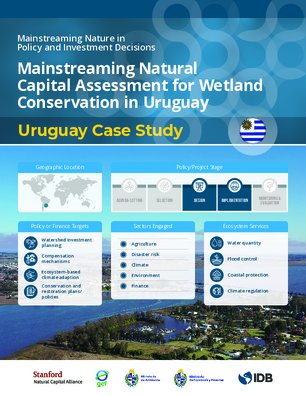
This project aimed to increase Uruguay's capacity to implement natural capital assessment and valuation approaches and apply them in the selection and design of policy and finance instruments. This is intended to strategically target investments in nature that increase the contributions of ecosystems, starting with wetlands, to the country's economy and people, and support greater ecological and climate resilience.
The pilot project in Uruguay conducted a natural capital assessment of the country's wetlands to support the implementation and financing of the decree. This included an economic valuation of four critical ecosystem services provided by wetlands across the country: flood risk mitigation, surface water provision for human consumption and agriculture, climate change mitigation (carbon storage), and coastal protection. In addition to the technical assessment, the team provided guidance on policy and finance instruments for strengthening implementation of the decree, including how natural capital information can support these efforts. This included identifying priority wetlands for protection and restoration, highlighting gaps in current protection coverage, proposing Key Performance Indicators (KPIs) for wetland-related financial instruments, assessing the potential of a complementary fiscal incentive, and identifying key information needs for the future development of additional conservation and finance mechanisms. The team included staff from the Ministry of the Environment DINABISE (Biodiversity and Ecosystem Services) and DINACC (Climate Change) offices, the Ministry of Economy and Finance, several consultants, and the Stanford Natural Capital Alliance (NatCap), in coordination with the Inter-American Development Bank (IDB).
The pilot project in Uruguay conducted a natural capital assessment of the country's wetlands to support the implementation and financing of the decree. This included an economic valuation of four critical ecosystem services provided by wetlands across the country: flood risk mitigation, surface water provision for human consumption and agriculture, climate change mitigation (carbon storage), and coastal protection. In addition to the technical assessment, the team provided guidance on policy and finance instruments for strengthening implementation of the decree, including how natural capital information can support these efforts. This included identifying priority wetlands for protection and restoration, highlighting gaps in current protection coverage, proposing Key Performance Indicators (KPIs) for wetland-related financial instruments, assessing the potential of a complementary fiscal incentive, and identifying key information needs for the future development of additional conservation and finance mechanisms. The team included staff from the Ministry of the Environment DINABISE (Biodiversity and Ecosystem Services) and DINACC (Climate Change) offices, the Ministry of Economy and Finance, several consultants, and the Stanford Natural Capital Alliance (NatCap), in coordination with the Inter-American Development Bank (IDB).


NO