Gender and Water in AquaFund
 Peer Reviewed
Date issued
March 2025
Subject
Water and Sanitation;
Gender;
Technical Cooperation;
Water Services;
Women;
Climate Finance;
Waterborne Disease;
Gender Mainstreaming;
Water Supply and Sanitation;
Sanitation Service;
Knowledge Product
JEL code
Q25 - Water;
O54 - Latin America • Caribbean;
J16 - Economics of Gender • Non-labor Discrimination;
F63 - Economic Development;
F35 - Foreign Aid
Category
Catalogs and Brochures
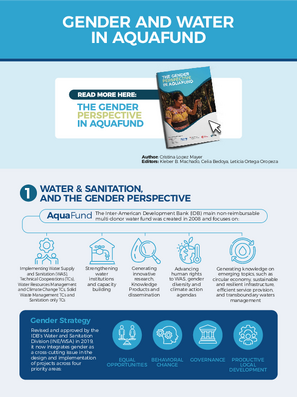
Women and girls use water for domestic activities and home-caring for vulnerable family members, as well as taking care of small cattle and agricultural production. Given their active use of water, women tend to be truly knowledgeable about current water sources, their quality and reliability, and any restrictions on their use. On the other hand, men use water for productive activities. Although women supply almost half of all agricultural labor in low-and middle-income countries, their agricultural productivity is on average 20 percent to 30 percent lower than male farmers. Therefore, agricultural activities supervised by men often take priority over those conducted by women. There is a need to integrate women in the planning, decision making and governance of water and sanitation services. AquaFund partners, the Water and Sanitation Division, and the entire IDB Group are committed to incorporating a gender perspective into their operations to achieve fairer, more equitable and sustainable results. This commitment is reflected in the current analysis of AquaFund Technical CooperationS (TCs) and their supported projects.


NO